Make a complaint

Last updated: 23 January 2026

You’ve been impacted by the collapse of Shield or First Guardian Master Fund and you want to get your money back – what do you need to do? This page provides information on how to ask for your super back from different financial businesses that were involved in your investment journey.

The AFCA complaint process

Most people who have lost money as a result of the collapse of Shield or First Guardian may be able to get some money back. This is because, for most people, it is likely that at least one of the financial businesses they have dealt with has broken the law or failed to do something they should have done causing the investor to lose money. 

While there may be other ways to get your super back, making a complaint to the Australian Financial Complaints Authority (AFCA) is free. It is also confidential – AFCA won’t publish your name or tell anyone about your complaint other than the business you complain about. 

This page explains the process of making an AFCA complaint as well as important information on who you can complain about, what you can complain about and deadlines for making a complaint. If you have questions after reading the information on this page, read our Frequently Asked Questions.

Ellen’s story

Ellen (not her real name) is a 48-year-old midwife. In 2023, she was contacted by a marketing firm about switching her super. The marketing firm passed her information onto a financial adviser who worked for 5 Point Financial Planning. The adviser recommended she move her super from Aware to New Quantum Super and invest in Shield and First Guardian Master Funds. The adviser didn’t talk to Ellen directly. Based on the advice, Ellen switched her super over. When both Shield and First Guardian collapsed, she lost a large amount of her nearly $250,000 of super.

Ellen made a complaint to AFCA about Financial Services Group Australia, which is the financial firm who authorised 5 Point Financial Planning to give advice. AFCA looked at the advice she was given and the work that the adviser did to understand what her needs were. AFCA also looked at what Ellen was told about the investments. 

After looking at all the information Ellen provided, AFCA agreed that the advice Ellen was given was inappropriate, did not consider her needs and contained information that was misleading. AFCA ordered Financial Services Group Australia to pay Ellen the amount of money that she lost on the investment (about $196,000 less anything she receives from the liquidator) plus interest.

Read more about Ellen.

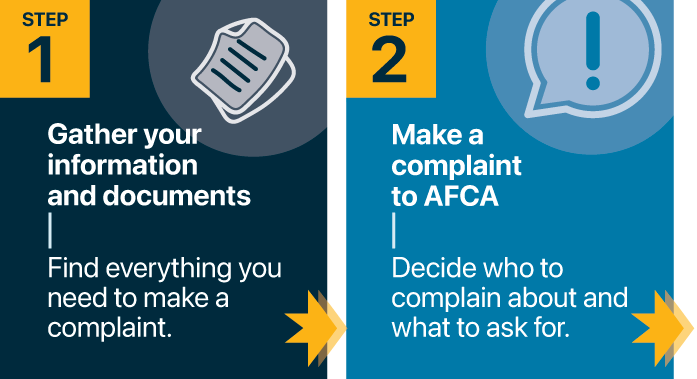
In order to make a complaint to AFCA, you will need to provide some information and documents which help AFCA to understand:

  • who you are making the complaint about;
  • what the financial business did and why that made you lose money;
  • what amount of money you lost because of the business (it’s okay if you don’t know the exact amount)
  • anything else you want the financial business to do.

AFCA has published a checklist which will help you figure out what information you need. AFCA also has an information pack which has a list of documents that you may need. The information pack has pictures of example documents to help you look for what you need.

Before you make your complaint, you can also watch videos showing you how to complete the complaint form so you know what to expect. AFCA also offers information and forms in other languages.

Who can I make a complaint about?

Types of financial businesses you can complain about

  • You can make a complaint about a financial adviser if you believe the financial advice you received was not in your best interests or broke the law. For example, you can complain if the advice you received was inappropriate, information you were given was untrue or misleading or the adviser didn’t follow your instructions or acted without asking for your consent. See below for more information about complaints against financial advisers.
  • If your super fund is Macquarie or Netwealth and you have been paid the money you originally invested back, you can still make a complaint about a financial adviser asking for other things. For example, if you received inappropriate advice, you can ask to be paid back the money you would have made if you had stayed in your old fund, or for advice fees you paid.
  • You can make a complaint about your super fund if you believe that the fund has made a decision about you that you think is unfair or unreasonable.
  • AFCA cannot deal with complaints about the general management of a super fund, including a fund’s decision to make an investment available for its members to invest in, the performance of that investment or how it was managed.
  • AFCA can deal with complaints about a super fund giving you wrong, incomplete or misleading information, acting in a misleading way when dealing with you, not managing your account correctly, not following your instructions, or failing to tell you about important information.
  • Find out which super funds allowed people to invest in Shield and First Guardian.
  • If you make a complaint about a super fund and AFCA tells you they are not able to consider your complaint, you should consider getting legal advice.
  • You can make a complaint about the responsible entities of Shield (Keystone Asset Management) or First Guardian (Falcon Capital) as long as the complaint isn’t about the general management of the fund, including the investments. But, because both of those companies are in administration, there isn’t likely to be any money to pay you even if AFCA awards you money.
  • You cannot make a complaint against an SMSF. This is because members run their own SMSFs and you would be making a complaint against yourself in most cases.
  • AFCA cannot deal with complaints about auditors or research houses (also called ratings agencies) or any other business that isn’t an AFCA member.

More information about complaints against financial advisers

You need to name the right business in your complaint

You can only make a complaint to AFCA about a financial advice business that is an AFCA member. This company is called the ‘financial advice licensee.’ 

Sometimes a financial advice licensee will allow or ‘authorise’ another company to give advice under their licence. That’s allowed, but the licensee is still responsible if that other company or its employees break the law. There were only five licensees who were involved with selling Shield and First Guardian, but there were many advice companies who worked for those five licensees. If you want to make a complaint, you need to make the complaint against the financial advice licensee. AFCA cannot accept a complaint if you make it against the wrong company, so it’s important to get it right.

Tip

You can check your advice documents for the name of the financial advice licensee. Their name should be listed on any advice documents that were given to you when you received financial advice.

If you know the name of a financial adviser, you can also use this tool to look up the name of the licensee to complain about.

You need to make your complaint before the deadline

AFCA can only deal with complaints about AFCA members. When a financial advice business shuts down, its AFCA membership will eventually expire, generally after one or two years. You will not be able to make a complaint to AFCA about the business after its AFCA membership expires. You won’t be eligible for compensation if you miss the deadline. 

It’s important you don’t miss the deadline. Complaint deadlines for each financial advice licensee are listed in the table below. You can use AFCA’s member search tool to confirm the business is still an AFCA member.

Financial advice licensee

Deadline to complain to AFCA

Financial Services Group Australia Pty Ltd
AFCA Member No: 10327

4 June 2026

Interprac Financial Planning Pty Ltd
AFCA Member No: 10416

6 years from when you first became aware of the loss, or 2 years after receiving a final response from Interprac if you complained to them directly first(whichever is earlier)

MWL Financial Services Pty Ltd.
AFCA Member No: 11054

25 August 2026

Next Generation Advice Pty Ltd.
AFCA Member No: 12450

18 April 2026

United Global Capital Pty Ltd
AFCA Member No: 40334

31 March 2026

What can I ask for?

Financial advice

If you make a complaint against a financial adviser in relation to Shield or First Guardian, you can ask for AFCA to award you:

  • Compensation for direct financial losses (money you lost directly because of the financial advice you got) up to $631,500 such as:
    • money you lost on the investment,
    • money you would have made in your old super fund if you hadn’t switched,
    • any fees you paid for the advice,
    • any tax you have to pay when you put this money back in your super account,
    • fees you paid to start a self-managed super fund or that you will have to pay to shut it down.
  • Compensation for indirect financial losses (money you lost as a result of the investment collapse) up to $6,300, such as:
    • interest on loans you took out when you couldn’t access your super to pay bills or buy things you needed,
    • penalties you paid when you couldn’t access your super to buy a home,
  • Compensation for non-financial losses up to $6,300, such as:
    • emotional distress about losing your savings.

Adding up the limits above, the maximum total amount of money that AFCA can award you for a financial advice complaint is $644,100 plus interest from the date of AFCA’s decision.

If your super fund is Macquarie or Netwealth and you have received the money you originally invested back, you can still make a complaint about a financial adviser asking for any of the other things listed above that are relevant to you.

Superannuation

If you make a complaint against a super fund in relation to Shield and First Guardian, you can ask for:

  • money you lost because of the way the super fund acted;
  • money you would have made if the super fund had acted properly (e.g. investment earnings);
  • return of any fees that should not have been charged to your account.

You cannot ask AFCA for compensation for non-financial losses (e.g. emotional distress) from a super fund.

There is no limit to the amount of money that AFCA can award you for a super fund complaint. Any money awarded to you will be paid to your super account.

Still have questions? Read our FAQs.

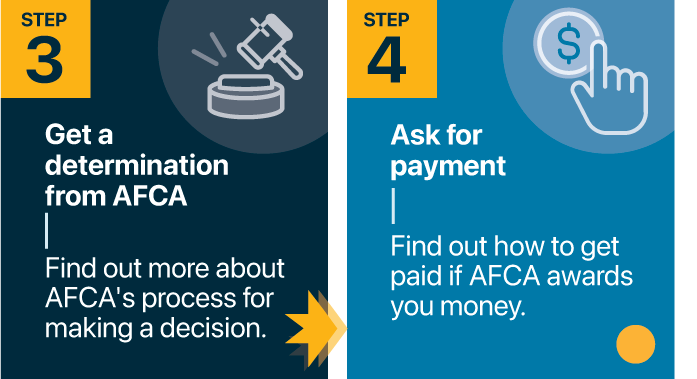
Once you have made a complaint to AFCA, your complaint will be handled according to AFCA’s usual process, which has three stages:

  • Registration and referral: AFCA will review your complaint, ask for any more information it needs and notify the business you have complained about. In most cases, AFCA will ask the business for a response to your complaint and encourage the business to try to resolve the issues.
    • If the business you complained about has shut down, AFCA may not try to contact them.
    • If there is a problem with your complaint (e.g. you have named the wrong business), AFCA will let you know.
    • If there is no problem with your complaint at this stage, AFCA may not contact you until it has an update for you.
  • Case management: If the complaint has not been resolved in the first stage, AFCA will assign a case manager to your complaint. The case manager will decide if AFCA needs any more information or documents. They will also decide whether the complaint can be resolved in a discussion with you, the case manager and the business, and may provide an early decision about the complaint. AFCA may skip this step where the complaint is:
    • urgent (e.g. you are in financial distress) or
    • low value.
  • Decision: If the complaint can’t be resolved and either you or the business disagrees with the early recommendation from the case manager, your complaint will go to a decision maker to be decided.
    • The  decision maker will take a fresh look at the complaint file, read all the information that AFCA has about your complaint from you and the business and then make a decision in writing. The decision maker does not have to agree with the case manager’s recommendation. 
    • AFCA does not have hearings like a court, so it’s important that you provide AFCA with all the information, documents and reasons for what you are asking for before the decision maker makes the decision.

Find out more about AFCA’s process.

How long will it take to get a decision?

In 2024-25, the average time it took for AFCA to close a complaint about investments or advice was 150 days and 116 days for a complaint about superannuation. AFCA has said it’s getting a lot of complaints about Shield and First Guardian and it’s taking longer than usual to deal with them due to how many there are. 

To give you a better sense of when you will get an AFCA case worker (the second stage of the process above), AFCA has created a page with timeframes for each of the five financial advice businesses that sold Shield and First Guardian. This page will be updated regularly.

Find out more about when you will get a case worker.

While AFCA generally deals with complaints in the order it receives them, it does prioritise complaints in special circumstances. For example, where someone is experiencing financial hardship or has other reasons why they need the complaint dealt with urgently. If you are facing special circumstances and need AFCA to process your complaint faster, make sure to include this information in your complaint.

It’s also important to know that some complaints take longer to deal with than others. AFCA must consider each complaint separately and make a decision based on the facts and evidence in each complaint. Complicated complaints take longer than simpler ones. Sometimes financial businesses are not cooperative and that makes things take longer.

If AFCA agrees with your complaint and awards you money, the business has to pay you. If they don’t, you need to report this to AFCA as soon as possible. 

  • If the business is still running, AFCA will take steps to try to make them pay. 
  • If the business has shut down, AFCA will work with the administrator, receiver or liquidator responsible for winding down the business to see if there is money to pay you. 

All of the super funds involved with Shield and First Guardian continue to operate and are likely to pay any money AFCA awards. Only one of the financial advice businesses that sold Shield or First Guardian to investors is still operating at the time of writing (Interprac). Interprac was involved with about half of all the people who invested in Shield and First Guardian. Successful AFCA complaints against the other advice businesses, which have shut down, will likely not get paid by those businesses.

If the advice business does not pay you after AFCA has taken reasonable steps to make them pay, you can apply for compensation from the Compensation Scheme of Last Resort (CSLR). The CSLR provides compensation of up to $150,000 per person to eligible consumers who have an unpaid determination from AFCA relating to certain types of complaints, including personal financial advice provided to retail clients about superannuation

Find out more about how to make a claim to the CSLR.


Where can I get more information?

See the links below for more information about each topic.

Error: